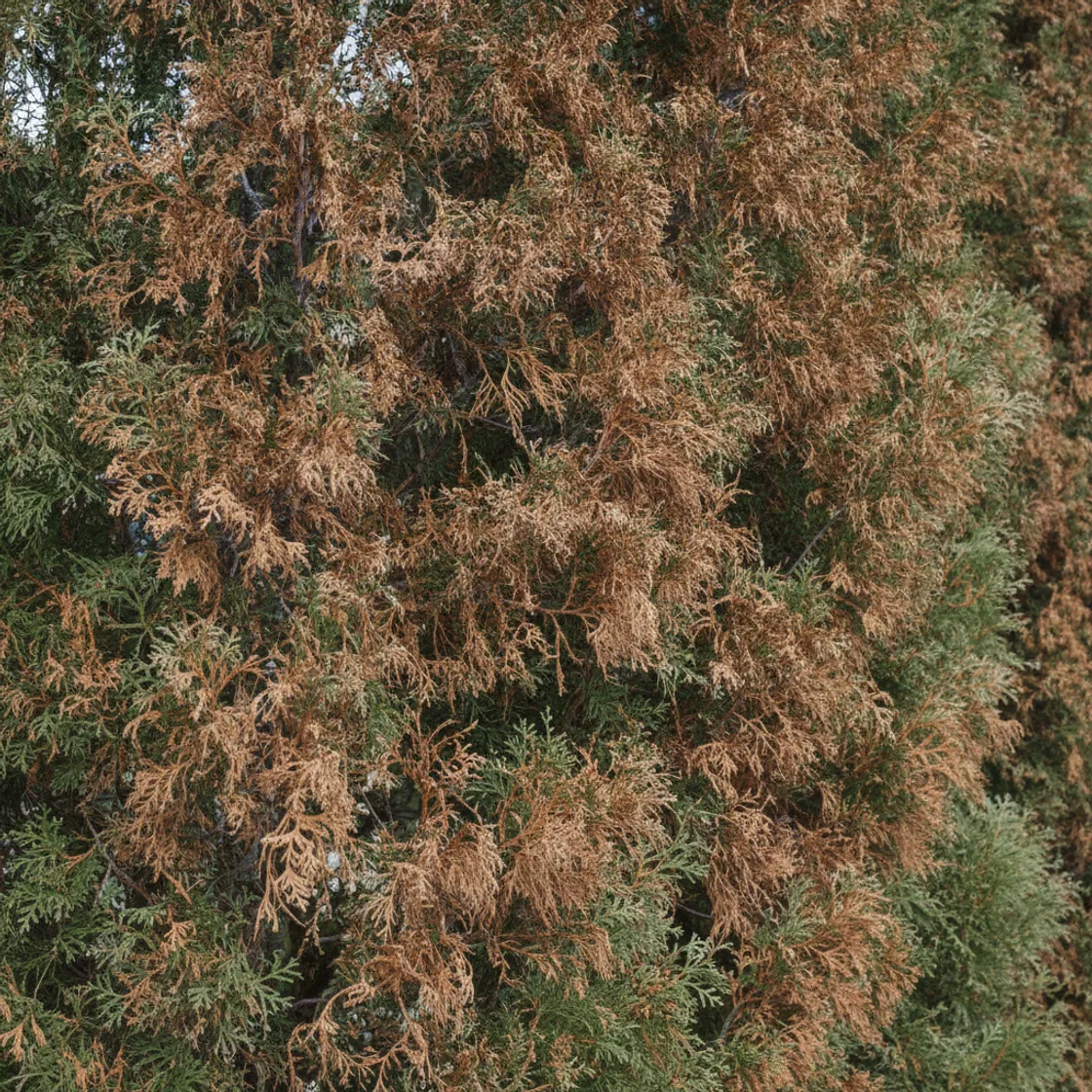
Leylands grow fast and fill in thick, which is exactly why so many homeowners plant them for privacy, and also why a problem in one tree can spread down a whole row before you notice. Browning has a few common causes here, and telling them apart is the first step to saving the screen.
Weather and root stress
The most common cause of browning is not a disease at all; it is stress. Leylands have shallow roots and do not love our heavy clay or our swings between drought and downpour. A hot, dry summer can brown out patches, especially on trees planted too close together where the roots are competing. Winter can do it too, when cold, dry wind burns the foliage faster than the roots can replace the water. Stress-browning is often worst on the side facing the weather and tends to be spread evenly rather than in a dead patch.
Canker disease
When browning shows up as a distinct dead branch or a section that dies back while the rest stays green, canker is a common culprit. Cankers are fungal infections that get into a branch, often through a wound or a stressed spot, and cut off the flow of water past that point, so everything beyond it browns and dies. You can sometimes find a sunken, discolored, or oozing lesion on the branch where the canker sits. Cankers spread most in stressed trees, which is why drought and crowding make everything worse.
Blight and mites
A couple of other problems round out the usual list. Needle blight, another fungal issue, tends to brown the inner and lower foliage first and thrives in wet, crowded, poorly circulated conditions. Spider mites, which multiply in hot dry weather, stipple the foliage a dull bronze and can be spotted by tapping a branch over white paper and looking for tiny specks that move. Each of these calls for a different response, which is why guessing is risky.
What actually helps
Depending on the cause, the useful steps are:
- Prune out clearly dead branches back to healthy wood to remove the source and improve airflow, cleaning tools between cuts so you do not spread a canker.
- Water deeply during drought, since a well-watered Leyland resists most of these problems far better than a stressed one.
- Improve air circulation where trees are crowded, which slows the fungal issues that thrive in still, damp foliage.
- Get an accurate diagnosis before reaching for a treatment, because what helps a mite problem does nothing for a canker.
How Engram's Tree Service can help
Because the cause of the browning changes what you should do, it is worth having someone who works on these trees look before you spend money on the wrong fix. Robin, our certified arborist, does exactly that kind of assessment, and if a tree in the row is truly dead we can remove it and clear the way for a replacement. Reach out for a free estimate and we will come take a look at the screen.